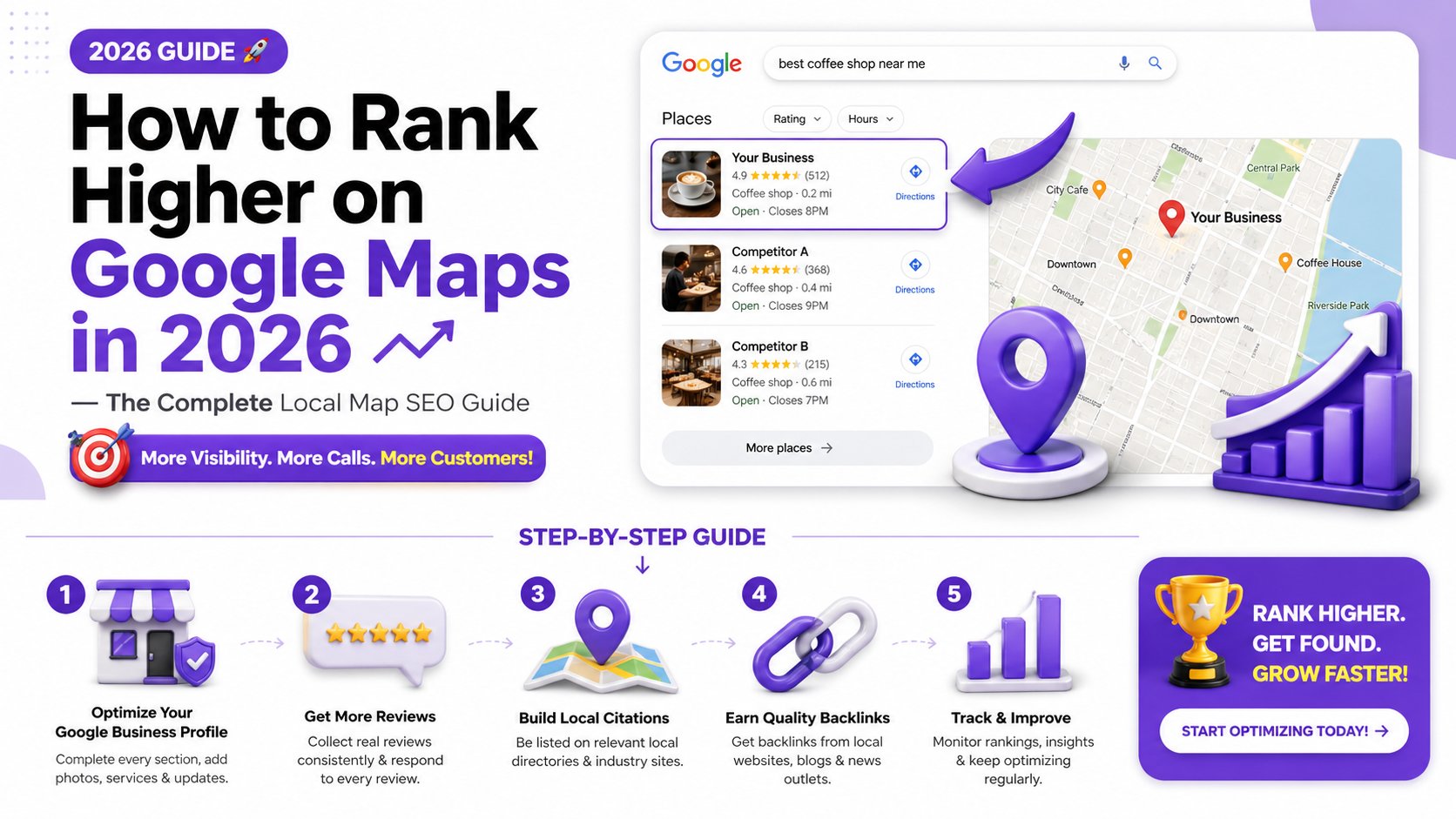
Ranking higher on Google Maps comes down to three things Google measures: relevance (does your profile match the searcher's intent?), proximity (how close is your business to the user?), and prominence (how well-known and trusted is your business online?).
In 2026, AI-driven local search results, LLM-based query interpretation, and entity-based relevance signals now play a larger role than ever. Businesses that fully optimise their Google Business Profile, build consistent citations, earn genuine reviews, and publish fresh content consistently dominate the local 3-Pack.
What Is Google Maps SEO? (And Why It Matters in 2026)
Google Maps SEO — also called Google Maps search engine optimization, Google Maps optimization, or local map optimization — is the process of improving your business's visibility and ranking position within Google Maps search results and the coveted local 3-Pack that appears at the top of Google Search.
When someone searches "best dentist near me," "plumber in Chennai," or "pizza delivery open now," Google surfaces a map with three local business listings above all organic results. Those three positions — the local 3-Pack — receive the majority of clicks, calls, and direction requests. Getting your business into that 3-Pack is what Google Maps SEO is all about.
In 2026, the stakes are even higher. Google's AI Overviews and Search Generative Experience (SGE) now pull local business data directly into AI-generated answers. LLMs (large language models) processing queries like "how do I rank higher on Google Maps" or "best google maps marketing agency near me" rely on structured local entity data — your GBP, your reviews, your citations — to determine whom to recommend. This is why Google Maps marketing and optimization has become the single most important local marketing channel for service-based businesses.
The 3 Core Google Maps Ranking Factors Explained
Google officially states that local rankings are determined by three core factors. Understanding these is the foundation of any effective Google Maps optimization strategy. Every ranking tactic below connects back to one or more of these three signals.
1. Relevance — Does Your Profile Match the Search?
Relevance measures how well your Google Business Profile matches what the searcher is looking for. Google's entity-understanding engine reads your business category, services list, description keywords, Q&A content, and even review text to determine whether your business is genuinely relevant to a given query.
In 2026, semantic relevance and entity relatedness have become critical. Google's LLM-based local search now understands that "plumber who fixes burst pipes in Chennai" and "emergency plumbing service Tamil Nadu" refer to the same entity and intent cluster — so your profile must explicitly signal all these related concepts, not just stuff in keywords.
2. Proximity — How Close Are You to the Searcher?
Proximity is the physical distance between your business location and the person searching. This factor is largely outside your control — but there are legitimate strategies to expand your local reach. Adding service areas, getting citations on neighborhood-specific directories, and publishing location-specific Google Posts all help signal geographic relevance for a wider area.
3. Prominence — How Well-Known Is Your Business?
Prominence measures how famous and trustworthy your business is, both online and offline. This encompasses your review count and average rating, the number and quality of directory citations, backlinks to your website, social media presence, press mentions, and your overall online reputation score.
The best Google Maps marketing agencies focus heavily on prominence building because it's the factor with the most levers to pull. A business with 200 reviews and consistent citations will almost always outrank a business with 20 reviews in a similar proximity zone, all else being equal.
Top 10 Proven Strategies to Rank Higher on Google Maps in 2026
The following strategies are ranked roughly in order of impact and are based on data from 100+ GBP profiles managed by the Digiman Marketing team. Apply all ten consistently — there is no shortcut to sustainable Google Maps SEO.
Fully Complete & Verify Your Google Business Profile
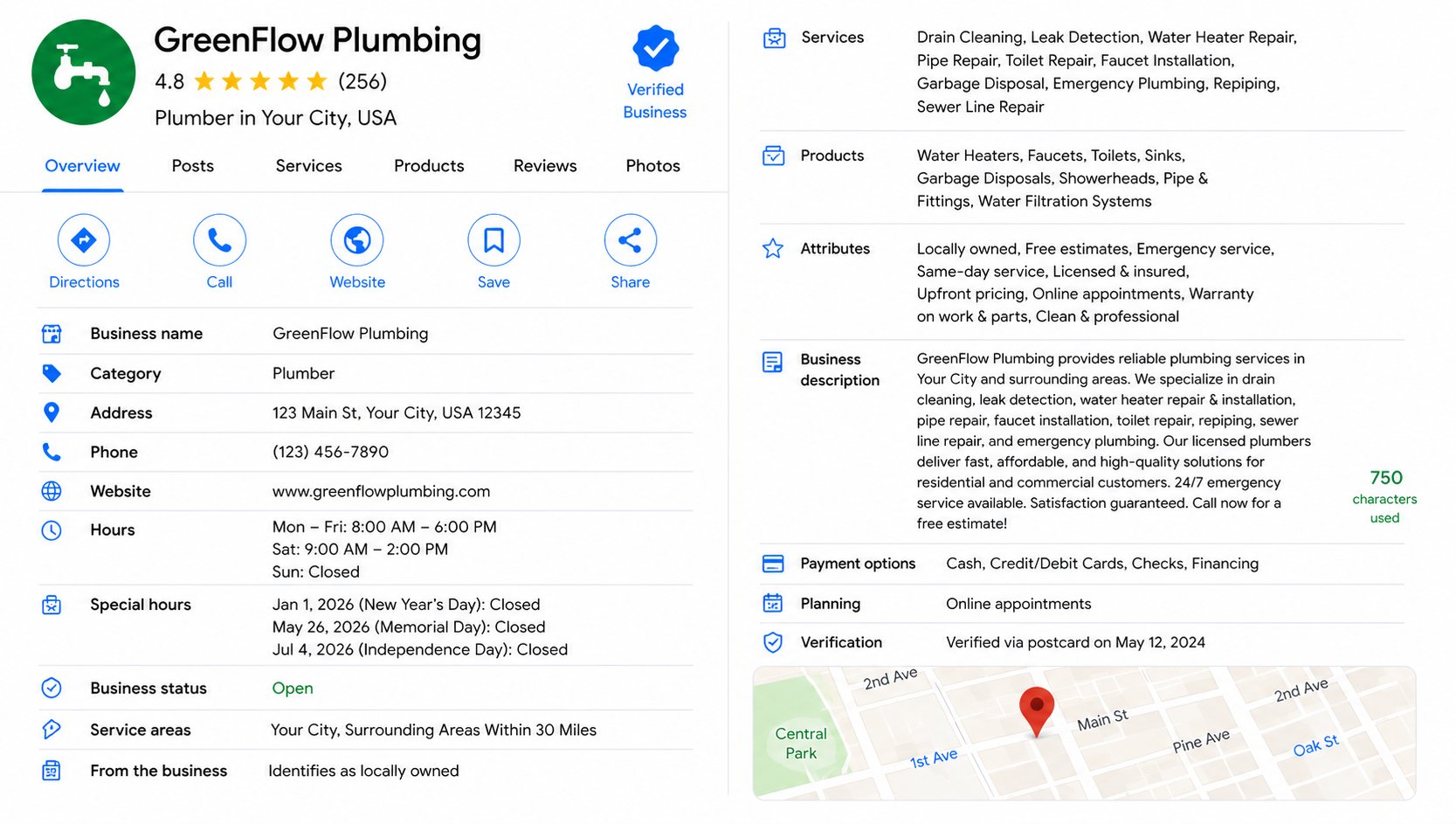
A 100% complete GBP profile ranks significantly better than a partial one. Fill in every field: business name, address, phone, website, hours (including special hours), services, products, attributes, and a compelling 750-character description rich with semantic keywords. Verification via postcard, phone, or video is mandatory — unverified profiles rarely appear in the 3-Pack.
Choose the Most Specific Primary Business Category
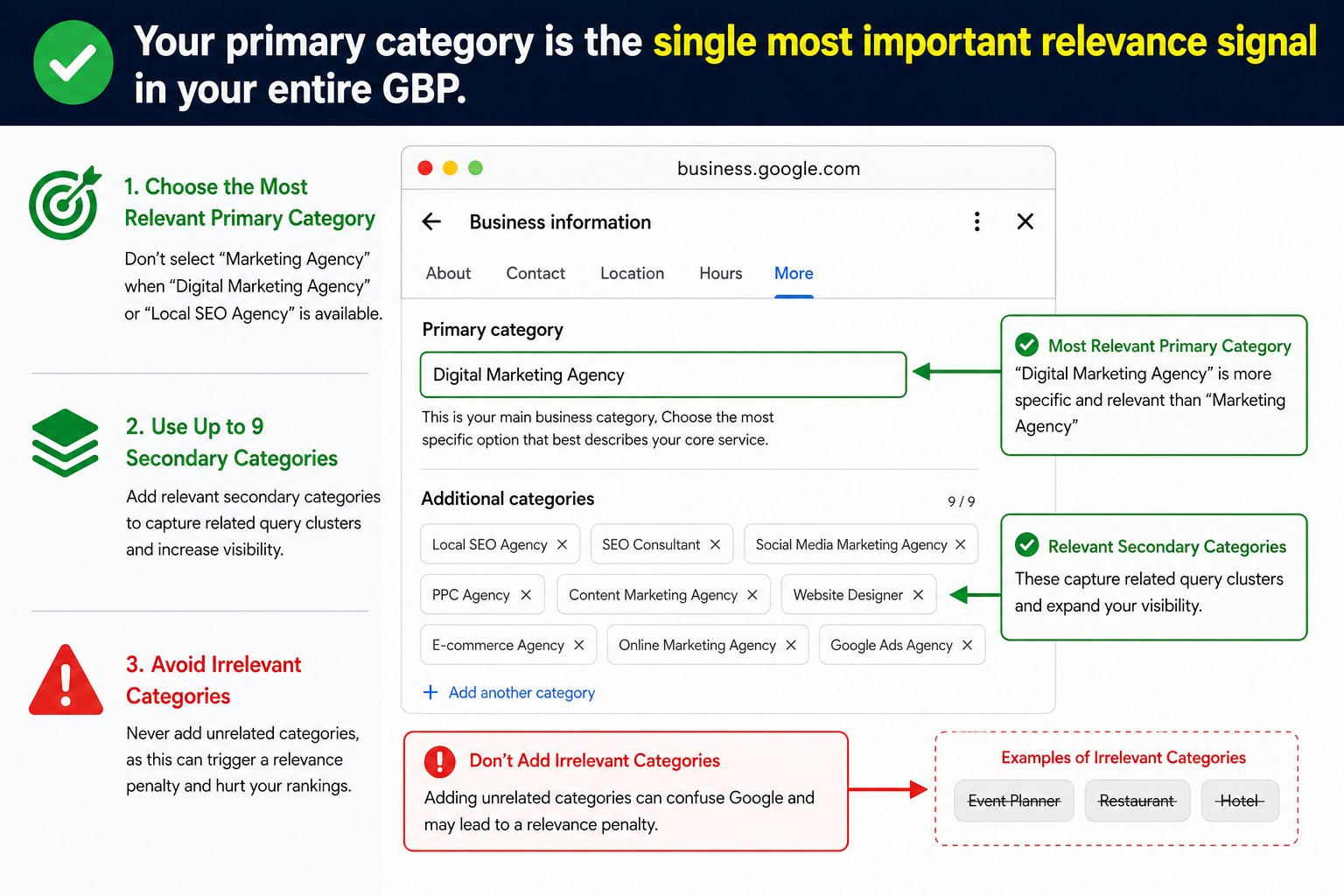
Your primary category is the single most important relevance signal in your entire GBP. Don't select "Marketing Agency" when "Digital Marketing Agency" or "Local SEO Agency" is available. Use up to 9 additional secondary categories to capture related query clusters — but never add irrelevant categories, as this can trigger a relevance penalty.
Build NAP Consistency Across All Citations
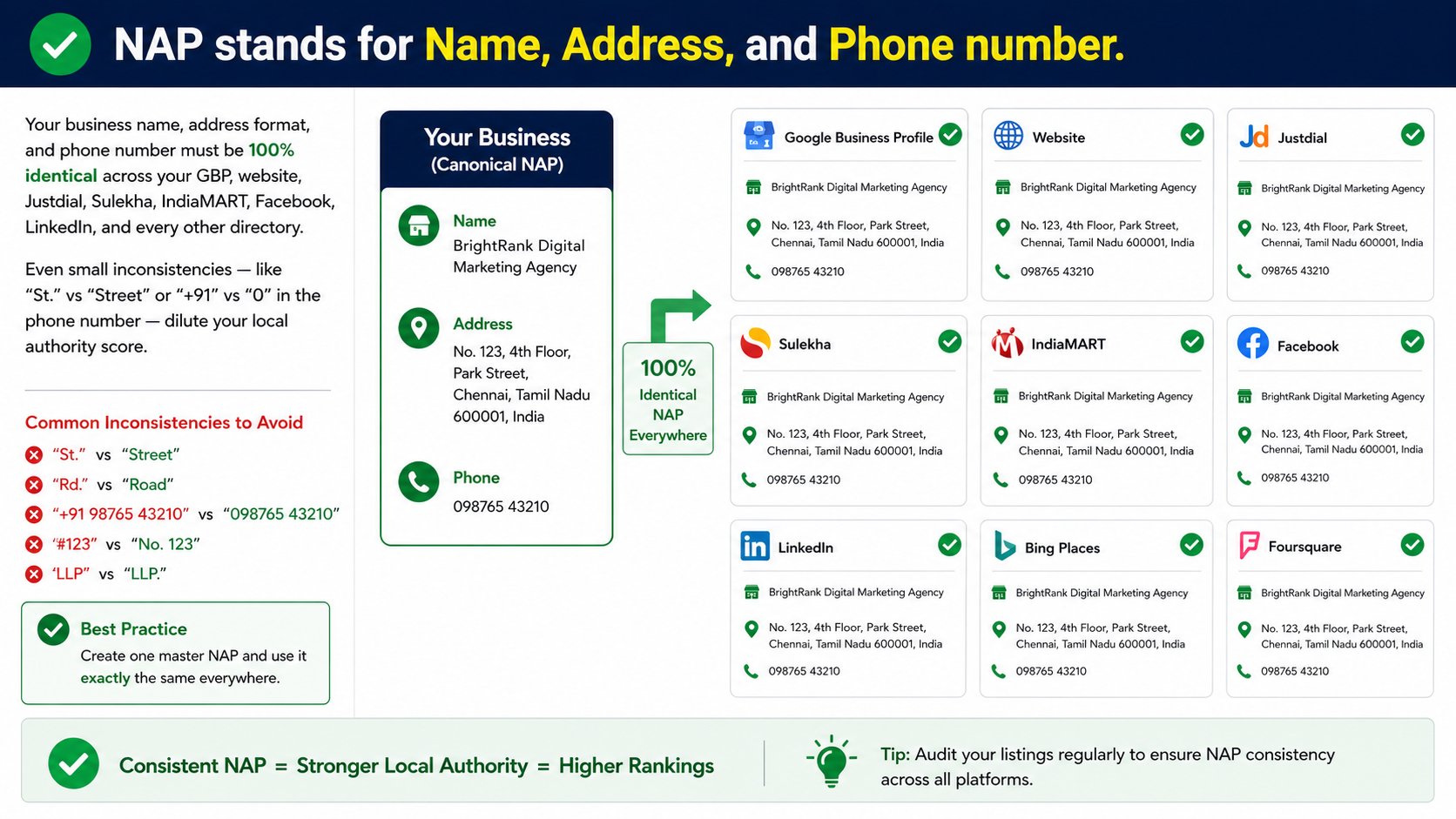
NAP stands for Name, Address, and Phone number. Your business name, address format, and phone number must be 100% identical across your GBP, website, Justdial, Sulekha, IndiaMART, Facebook, LinkedIn, and every other directory. Even small inconsistencies — like "St." vs "Street" or "+91" vs "0" in the phone number — dilute your local authority score.
Generate & Respond to Google Reviews Consistently
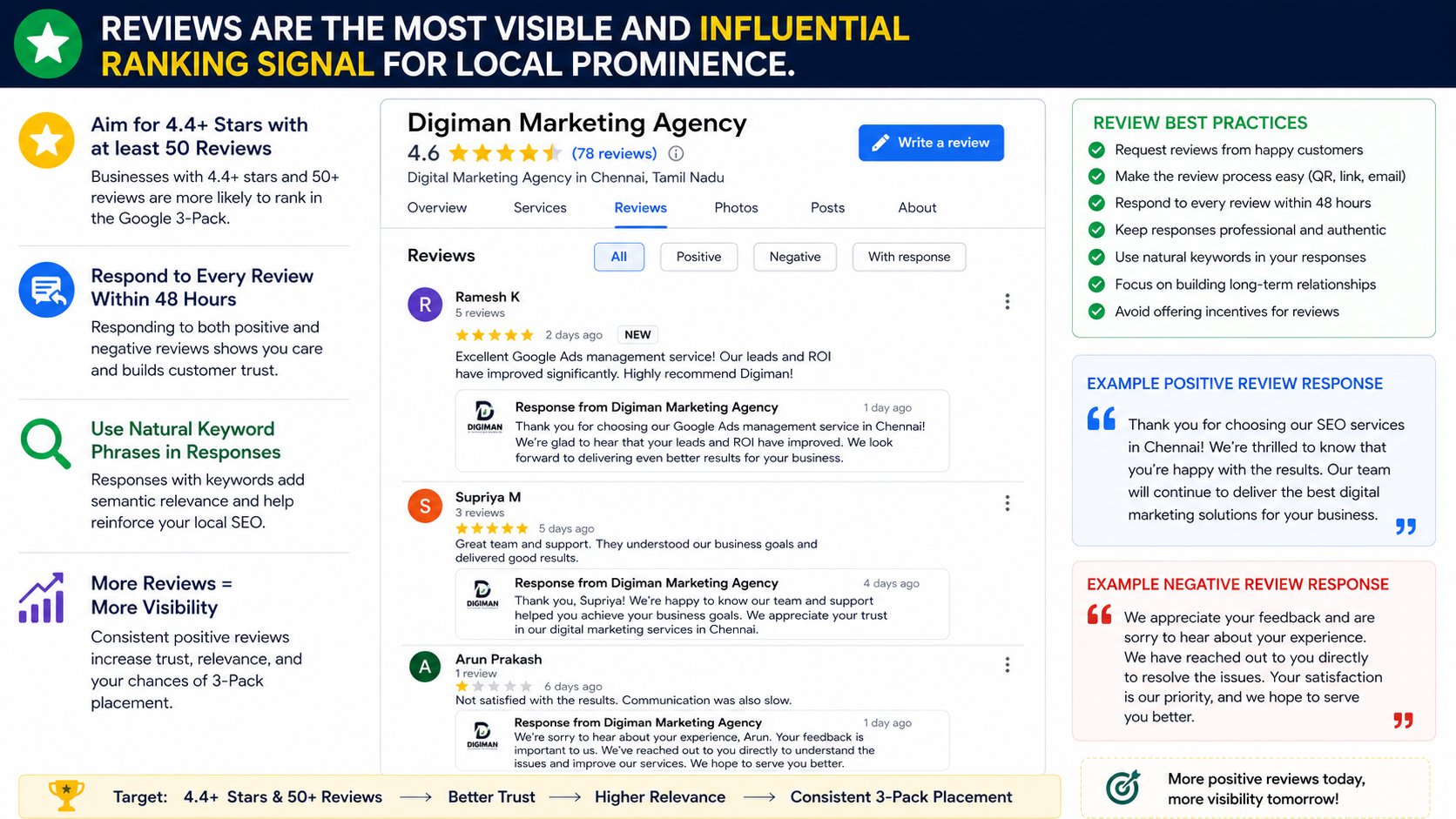
Reviews are the most visible and influential ranking signal for local prominence. Aim for a minimum of 4.4 stars with at least 50 reviews before you expect consistent 3-Pack placement. Respond to every review — positive and negative — within 48 hours. Responses that include natural keyword phrases (e.g., "Thank you for choosing our Google Ads management service in Chennai") add additional semantic relevance signals.
Upload Geo-Tagged, High-Quality Photos Weekly
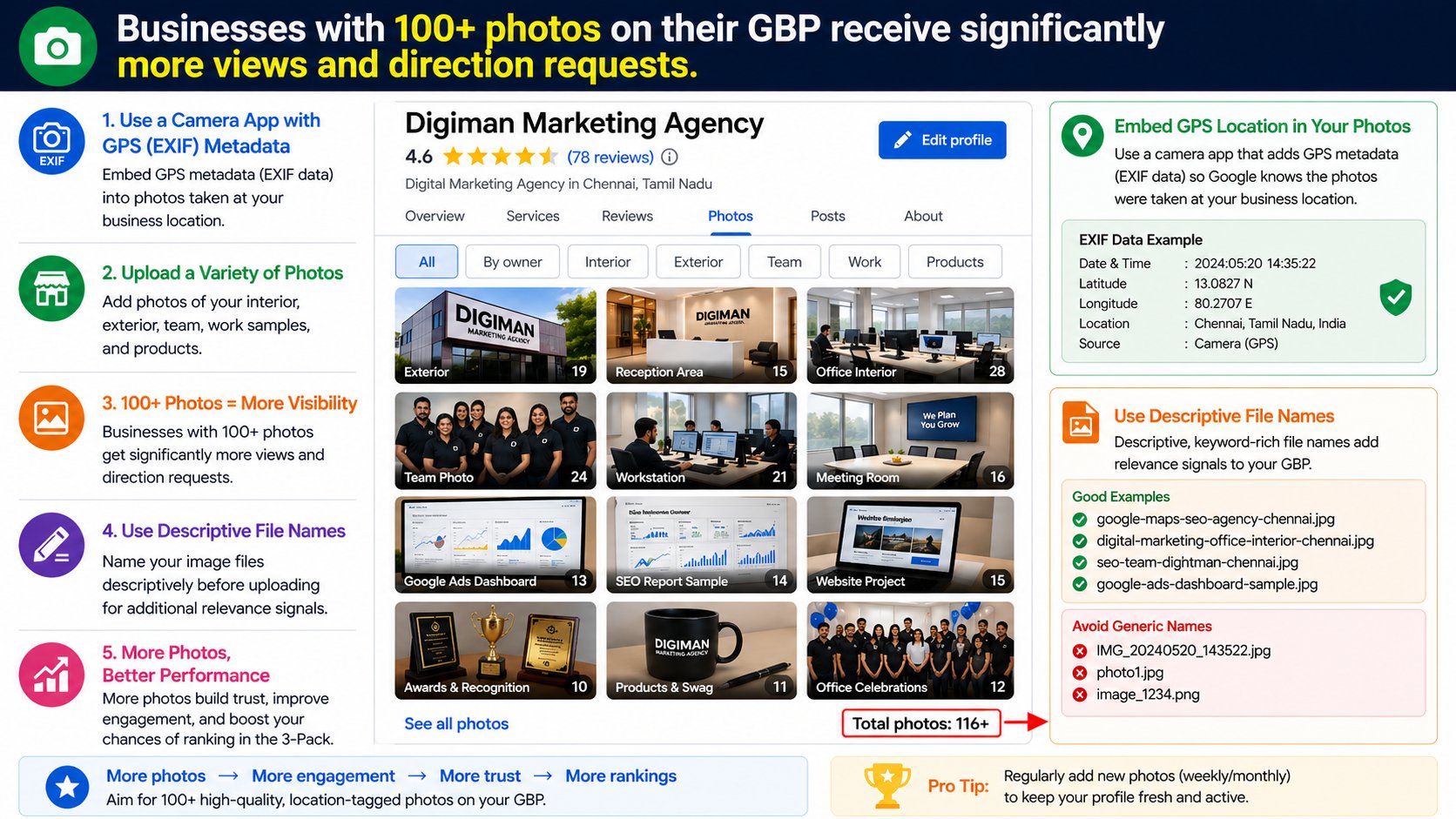
Businesses with 100+ photos on their GBP receive significantly more views and direction requests. Use a camera app that embeds GPS metadata (EXIF data) into photos taken at your business location. Upload photos of your interior, exterior, team, work samples, and products. Name your image files descriptively before uploading — e.g., google-maps-seo-agency-chennai.jpg — for additional relevance signals.
Publish Weekly Google Posts with Local Keywords
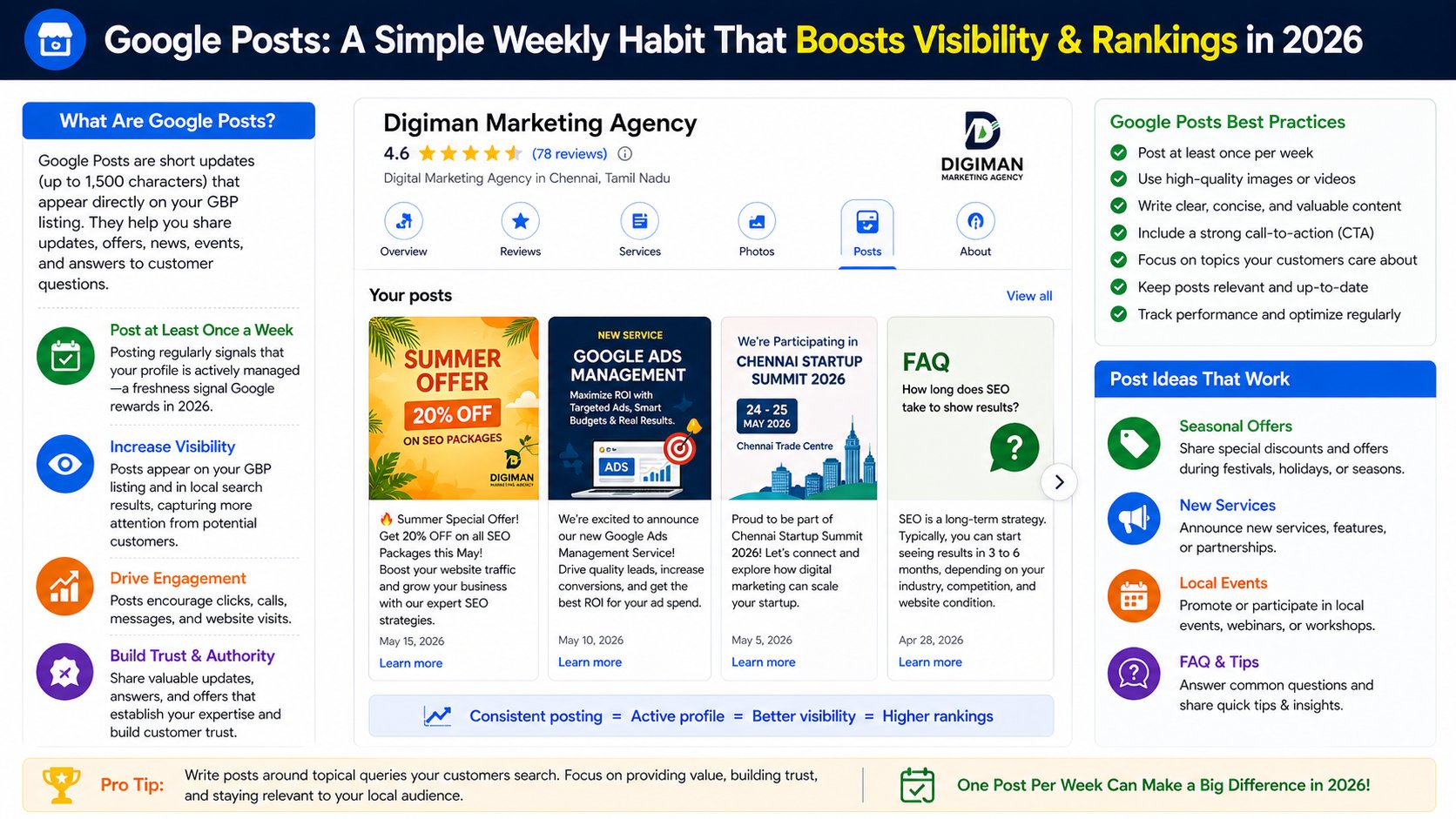
Google Posts are short updates (up to 1,500 characters) that appear directly on your GBP listing. Publishing at least one post per week signals that your profile is actively managed — a freshness signal Google rewards in 2026. Write posts around topical queries your customers search: seasonal offers, new services, local events, and FAQ-style answers.
Optimise Your Website for Local SEO & Embed a Google Map
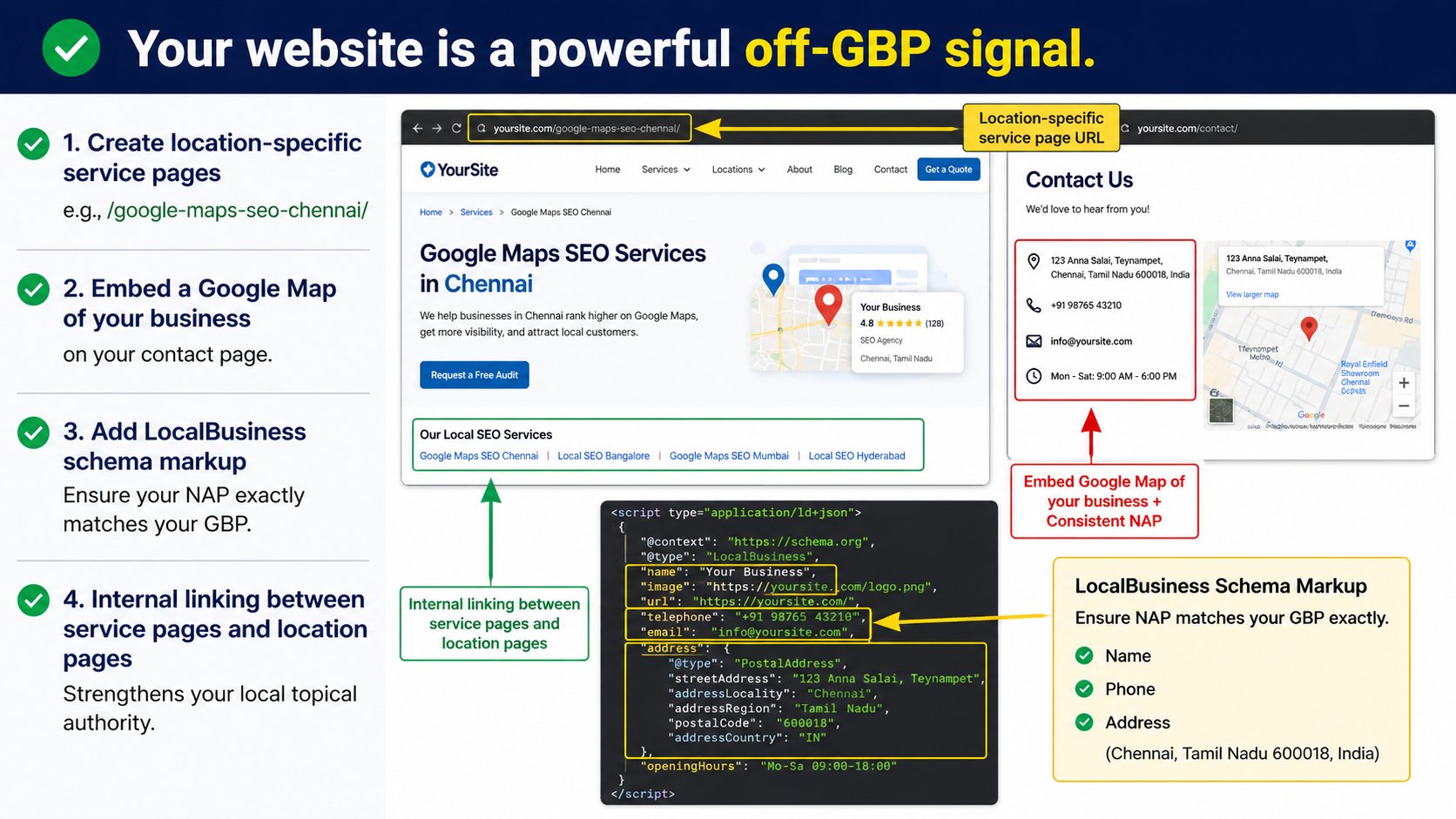
Your website is a powerful off-GBP signal. Create location-specific service pages (e.g., /google-maps-seo-chennai/), embed a Google Map of your business on your contact page, add LocalBusiness schema markup, and ensure your website's NAP exactly matches your GBP. Internal linking between service pages and location pages strengthens your local topical authority.
Build High-Quality Local Citations & Backlinks
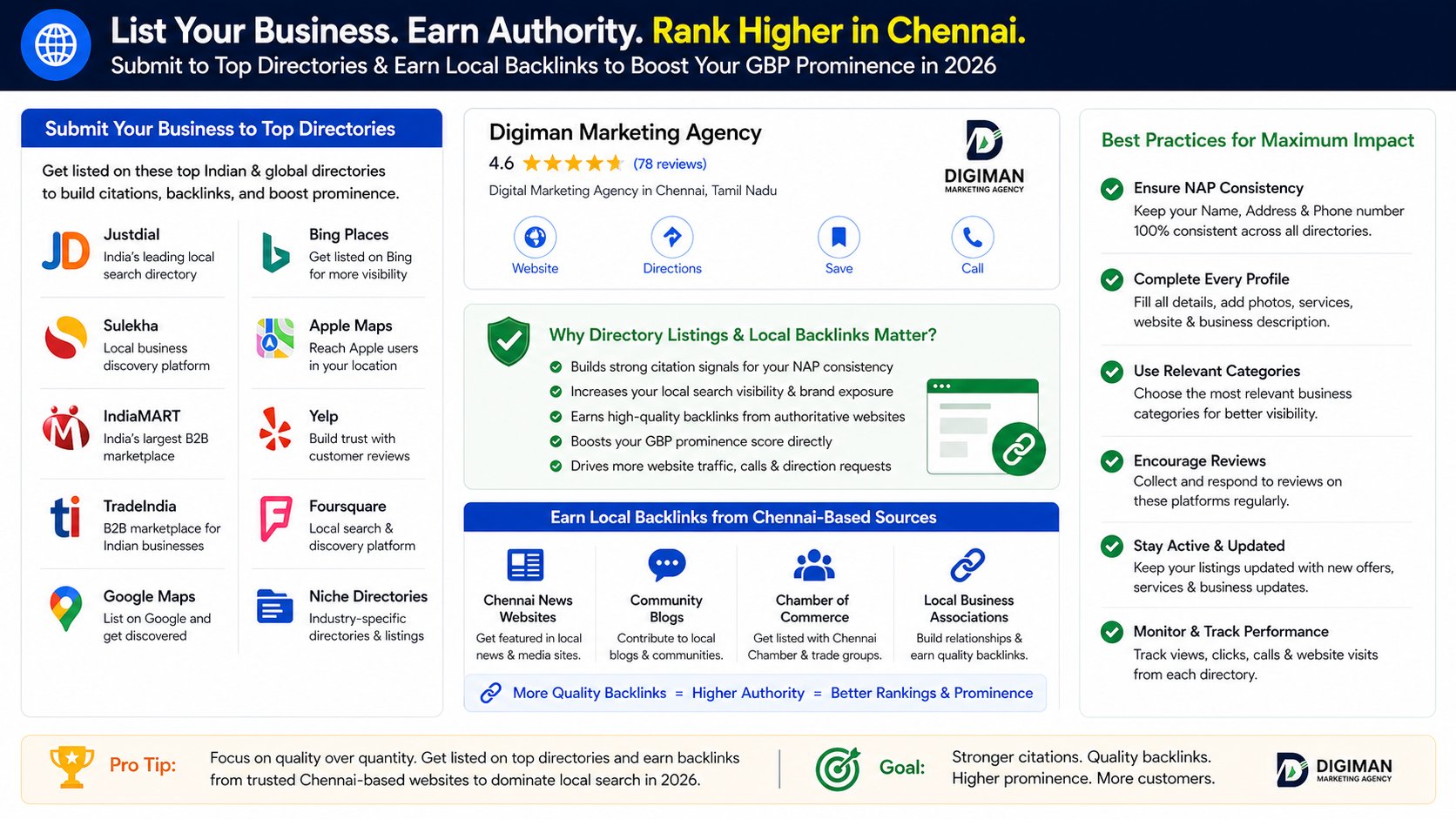
Submit your business to top Indian and global directories: Justdial, Sulekha, IndiaMart, TradeIndia, Google Maps, Bing Places, Apple Maps, Yelp, Foursquare, and niche industry directories. Earn local backlinks from Chennai-based news sites, community blogs, and chamber of commerce listings. These external authority signals directly improve your prominence score.
Use Google Q&A to Seed Keyword-Rich Answers
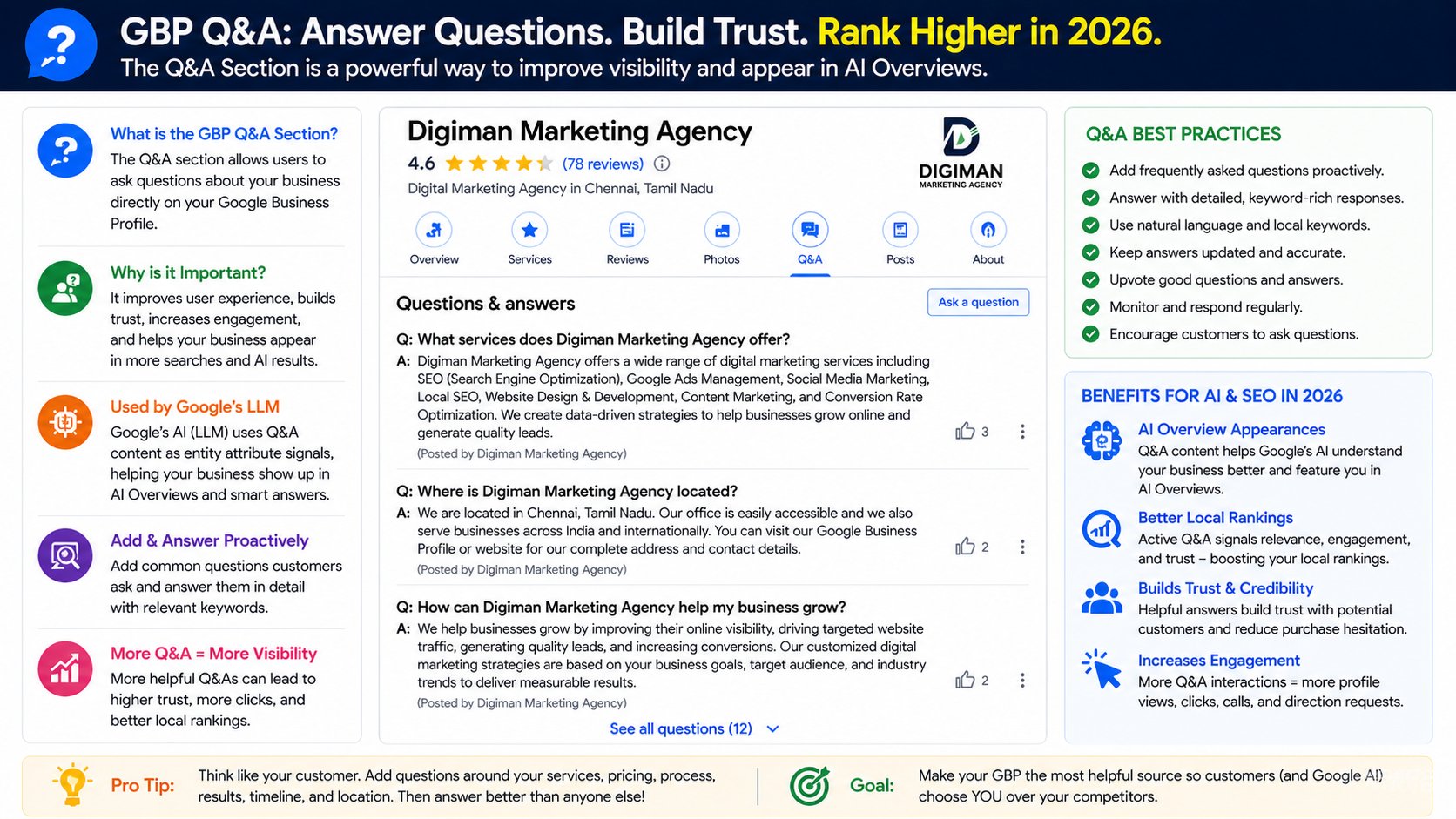
The Q&A section of your GBP is often overlooked but highly valuable. Proactively add questions your customers commonly ask and answer them with detailed, keyword-rich responses. Google's LLM search engine uses Q&A content as entity attribute signals — making it especially important for AI Overview appearances in 2026.
Track Rankings & Audit Monthly with a Grid Rank Tracker
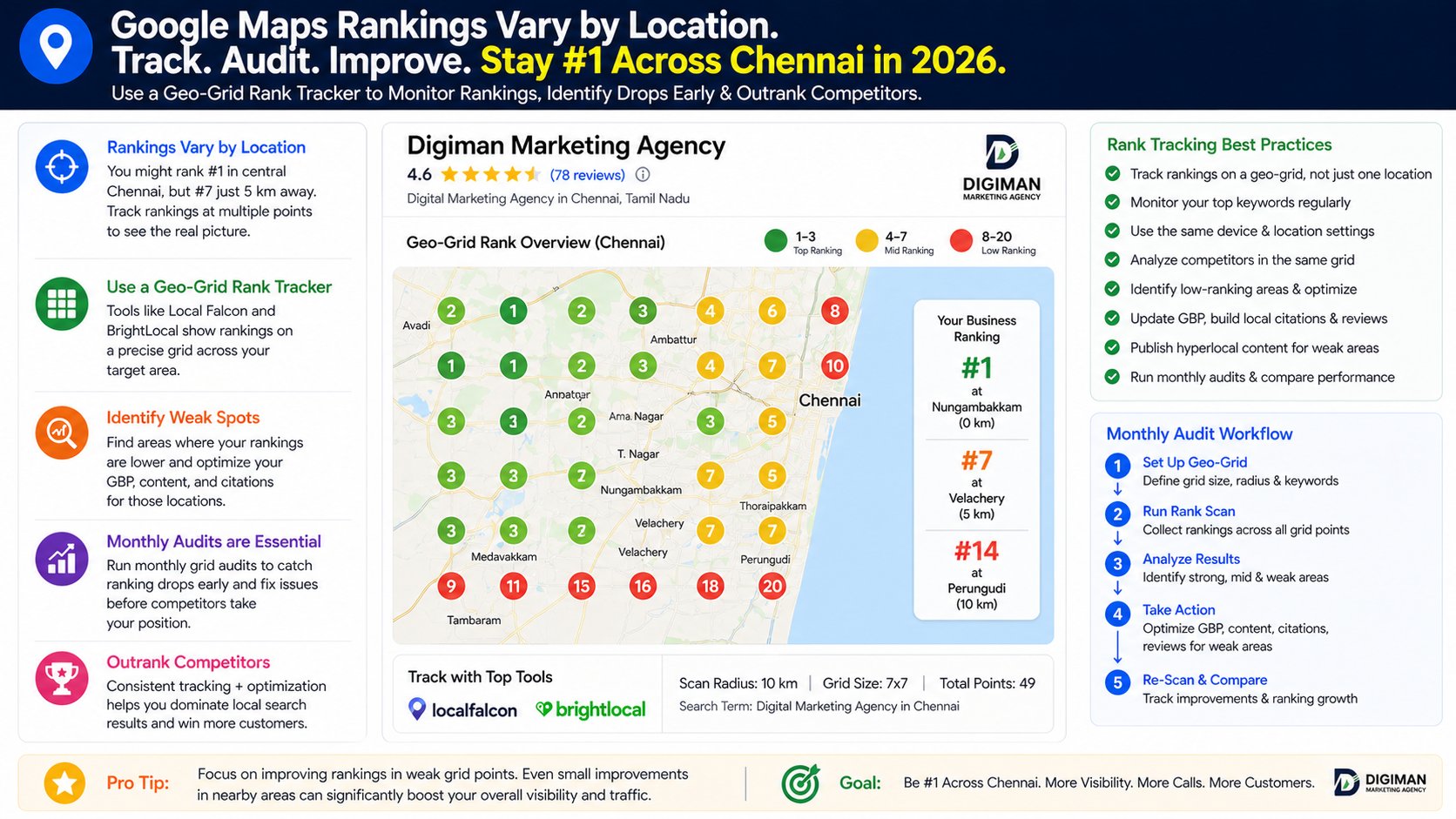
Google Maps rankings vary by geographic location — you might rank #1 at the centre of Chennai but #7 five kilometres away. Use a geo-grid rank tracker (e.g., Local Falcon, BrightLocal) to see your exact rankings across a grid of locations. Monthly audits help you identify ranking drops early and course-correct before competitors take your position.
Want Us to Rank Your Business on Google Maps?
Digiman Marketing is Chennai's top-rated Google Maps SEO company. Get a free audit and ranking roadmap — no commitment required.
Google Maps SEO vs. Traditional SEO — Key Differences
Many business owners confuse Google Maps SEO with traditional website SEO. While they overlap in areas like backlinks and content quality, they are distinct disciplines with different ranking mechanisms and timelines. Understanding the differences helps you allocate your marketing budget more effectively.
| Factor | Google Maps SEO | Traditional SEO |
|---|---|---|
| Primary Platform | Google Business Profile (GBP) | Your Website |
| Key Signals | Reviews, proximity, citations, photos | Backlinks, on-page content, Core Web Vitals |
| Local Targeting | Very strong — geo-specific | Moderate — requires local pages |
| Conversion Rate | Higher (calls, directions, visits) | Lower (requires more funnel stages) |
| Time to Results | 30–90 days (typical) | 3–12 months (typical) |
| AI/LLM Visibility | High — pulls into AI Overviews | Growing — depends on authority |
| Cost Efficiency | High ROI for local businesses | High ROI but slower payback |
| Best For | Service-area businesses, retail, restaurants | E-commerce, SaaS, national brands |
The smartest local businesses invest in both Google Maps SEO and traditional SEO simultaneously. Your GBP drives immediate calls and foot traffic while your website builds long-term authority. A professional Google Maps marketing agency will manage both as an integrated local presence strategy.
Best Google Maps SEO Services — What a Top Agency Does for You
Choosing the right Google Maps marketing company or Google Maps SEO company can be the difference between a dormant listing and a lead-generating machine. Here's what the best agencies — like Digiman Marketing — actually do for clients:
GBP Full Optimisation
Complete profile setup, category research, description writing with semantic keywords, services and products listing, and attributes configuration.
Review Generation & Management
Ethical review request systems, response templates, negative review management, and review velocity monitoring for consistent star rating growth.
Citation Building & Audit
Comprehensive citation audit, duplicate listing suppression, NAP correction across 50+ directories, and ongoing citation monitoring for consistency.
Geo-Grid Rank Tracking
Monthly geo-grid ranking reports showing your exact Maps positions across your service area — with competitor benchmarking and trend analysis.
Local Landing Page SEO
Location-specific website pages with LocalBusiness schema, embedded maps, local content, and internal linking — powering your GBP from the website side.
Google Posts & Content Calendar
Weekly Google Post creation, offer posts, event posts, and product highlights — maintaining the freshness signals Google rewards in 2026.
Google Shopping Expert Integration with Google Maps Listings
If you run a retail business or sell products, integrating Google Shopping with your Google Maps presence creates a powerful combined visibility strategy. In 2026, Google Maps listings for retail businesses can surface product panels directly within the 3-Pack — showing your inventory, prices, and availability.
Working with a Google Shopping expert or Google Shopping specialist alongside your Google Maps SEO campaign delivers compounding results:
- Local Inventory Ads show your products to nearby shoppers searching on Maps and in Google Search — a direct bridge between Google Shopping and Google Maps SEO.
- Product panels on GBP display your catalogue, pricing, and "In Stock Near You" signals — increasing click-through rates from the 3-Pack by up to 35%.
- Google Shopping campaigns drive brand searches, which increase your GBP click signals — a positive feedback loop for Maps ranking.
- Performance Max campaigns now serve across Search, Maps, Shopping, YouTube, and Display simultaneously — managed by experienced Google Ads specialists.
Digiman Marketing's team includes certified Google Shopping specialists and Google Ads experts who integrate Shopping and Maps campaigns for maximum local ROI.
Google Maps SEO Pricing — How Much Does It Cost in 2026?
One of the most common questions we receive: "How much does Google Maps marketing cost?" Pricing varies based on competition, number of locations, and the scope of services. Below is a realistic pricing guide for the Indian market in 2026:
Starter
- GBP full setup & optimisation
- Category & keyword research
- 25 citation submissions
- Review generation system
- Monthly rank report
Growth
- Everything in Starter
- Weekly Google Posts
- 50+ citation submissions
- Geo-grid rank tracking
- Local landing page SEO
- Review response management
Authority
- Everything in Growth
- Competitor gap analysis
- 100+ citation submissions
- Local link building
- Google Shopping integration
- AI Overview optimization
AI Overviews, LLM Queries & Google Maps SEO in 2026
The biggest shift in local search in 2026 is the integration of AI-generated answers (AI Overviews, formerly SGE) into Google Search results. When someone asks Google an LLM-style query like "what is the best google maps marketing company in Chennai" or "how do I rank on google maps for free," Google's AI now synthesizes an answer from multiple sources — including your GBP, your website content, your reviews, and third-party mentions.
To appear in AI Overviews for local search queries, your business needs:
- Entity authority — your business must be a clearly understood, consistently described entity across GBP, your website, and citations.
- AI-distance relevance signals — structured data (LocalBusiness schema) that tells Google's AI your exact service area, opening hours, and service specialisations.
- LLM-friendly content — concise, factual, first-person answers to common customer questions (FAQ pages, Q&A on GBP, detailed service descriptions).
- Review sentiment signals — Google's AI reads review content to understand what customers praise about your business and uses this to match your profile to specific query intents.
- Freshness signals — recent posts, photos, and review responses tell Google's AI that your listing is actively managed and up to date.
✓ LocalBusiness schema on website ✓ FAQ page with LLM-style Q&A ✓ GBP Q&A section seeded with keyword-rich answers ✓ Reviews with keyword mentions (respond to encourage these) ✓ Weekly Google Posts published ✓ Consistent entity name across all platforms ✓ Wikipedia/Wikidata entry if brand is established
The Ultimate Google Maps Optimization Checklist for 2026
Use this actionable checklist to audit your current Google Maps presence. Each item represents a ranking signal. The more boxes you can check, the stronger your local map SEO foundation will be.
- Google Business Profile claimed, verified, and 100% complete with all fields filled
- Most specific primary category selected, plus up to 9 relevant secondary categories
- Business description written with semantic keywords — 750 characters, no keyword stuffing
- All services and products added with descriptions and prices
- Business hours accurate, including special hours for holidays
- NAP 100% identical across GBP, website, and all citations
- Minimum 50 genuine 5-star reviews with keyword-rich content
- All reviews responded to within 48 hours
- Minimum 100 photos uploaded, including geo-tagged exterior and interior shots
- Weekly Google Posts published (offers, updates, events, Q&A)
- GBP Q&A section seeded with at least 10 relevant questions and detailed answers
- 50+ consistent citations across top Indian and global directories
- LocalBusiness schema markup on website
- Google Map embedded on website contact/location page
- Service area set correctly in GBP (for service-area businesses)
- Geo-grid rank tracker set up for monthly monitoring
- GBP connected to Google Ads for Local campaigns
- Messaging enabled on GBP for direct customer contact
Skip the Guesswork — Let Our Specialists Handle It
Digiman Marketing's Google Maps SEO team manages ranking campaigns for 100+ businesses across Tamil Nadu. Let us audit your profile and build your ranking roadmap.
Frequently Asked Questions — Google Maps SEO, Ranking & Local Marketing
How to Rank Higher on Google Maps in 2026?
Rank higher on Google Maps by fully completing your Google Business Profile, choosing the most specific primary category, earning 50+ genuine reviews, uploading geo-tagged photos weekly, publishing Google Posts, and building consistent NAP citations across all major directories. All six signals must work together for sustained 3-Pack placement.
How to Rank Higher in Google Maps Without Paying for Ads?
You can rank higher in Google Maps organically — without paying for ads — by optimising your free Google Business Profile, requesting customer reviews consistently, uploading photos, seeding Q&A, and publishing weekly Google Posts. These organic tactics alone can secure 3-Pack placement in low-to-medium competition markets.
How Do I Rank Higher on Google Map for My Local Business?
To rank your local business higher on Google Maps, verify your GBP at your real business address, select hyper-specific service categories, respond to every review within 48 hours, embed a Google Map on your contact page, and add LocalBusiness schema markup to your website. Consistent NAP data across Justdial, Sulekha, and IndiaMART also boosts prominence significantly.
How to Rank on Google Maps Fast — What Works Quickest?
The fastest ways to rank on Google Maps are: completing every GBP field immediately, generating a burst of genuine reviews from real customers, and fixing any NAP inconsistencies across directories. Review velocity — earning fresh reviews consistently — is the single fastest-moving lever most businesses can pull within days, not months.
What Is Google Maps Optimization and Why Does It Matter?
Google Maps optimization is the process of improving your Google Business Profile and off-profile signals so your business appears higher in Maps search results and the local 3-Pack. It matters because 46% of all Google searches have local intent — and businesses in the 3-Pack capture the vast majority of calls, direction requests, and website visits from local searchers.
What Does Google Maps Search Engine Optimization Include?
Google Maps search engine optimization includes GBP profile completion and verification, primary and secondary category selection, review generation and response strategy, geo-tagged photo uploads, Google Posts publishing, NAP citation building, LocalBusiness schema on your website, geo-grid rank tracking, and monthly performance audits. All signals work together to build relevance, proximity, and prominence.
How Long Does Google Maps SEO Take to Show Results?
Most businesses see measurable Google Maps ranking improvements within 30–90 days of consistent optimization. Low-competition niches can show movement in 2–4 weeks. Highly competitive markets like digital marketing agencies or healthcare in major cities like Chennai typically require 3–6 months of sustained effort before reaching stable top-3 positions.
What Is a Google Maps SEO Company and What Do They Do?
A Google Maps SEO company specialises in improving your business's visibility within Google Maps and the local 3-Pack. They manage GBP optimisation, citation building, review strategy, geo-grid tracking, and website local SEO signals. A reputable Google Maps SEO company like Digiman Marketing also provides monthly reporting, competitor analysis, and proactive ranking recovery when drops occur.
How Do I Choose the Best Google Maps SEO Company in Chennai?
Choose a Google Maps SEO company in Chennai that manages real GBP profiles (ask for a client list), provides geo-grid rank tracking reports, doesn't promise overnight results, and offers transparent monthly reporting. Avoid companies that offer bulk reviews or fake citations — these violate Google's guidelines and risk permanent GBP suspension. Digiman Marketing offers a free audit before any commitment.
What Does a Google Maps Marketing Company Actually Deliver?
A Google Maps marketing company delivers measurable growth in GBP metrics: more profile views, map clicks, direction requests, calls, and website visits from local searchers. They combine organic Maps optimisation with local content strategy and, optionally, paid Local Search Ads to dominate both organic and paid positions in the local 3-Pack simultaneously for maximum visibility.
What Is a Google Maps Marketing Agency and Do I Need One?
A Google Maps marketing agency manages your local search presence end-to-end — from GBP setup and optimisation to citation building, review management, and rank tracking. You need one if you're in a competitive local market, managing multiple locations, or not seeing 3-Pack rankings despite doing basic optimisation yourself. Agencies bring tools, processes, and data that individual businesses rarely have in-house.
How Much Does Google Maps Marketing Agency Service Cost in India?
Google Maps marketing agency services in India typically cost ₹5,000–₹25,000 per month depending on competition level, number of locations, and scope. Digiman Marketing offers Google Maps SEO packages starting from ₹7,999/month, including GBP optimisation, citation building, review strategy, geo-grid tracking, and monthly reporting. Request a free audit for a custom quote.
What Is Google Shopping and How Does It Work with Google Maps?
Google Shopping displays product listings with images, prices, and store details directly in Google Search. When integrated with your GBP, Google Shopping can trigger local inventory panels alongside your Maps listing — showing searchers that your product is available nearby. This combination of Google Shopping and Maps SEO creates powerful dual visibility for retail businesses targeting local buyers.
Do I Need a Google Shopping Expert to Run Product Campaigns?
Yes — a Google Shopping expert significantly improves campaign ROI. Google Shopping campaigns require a correctly structured product feed, optimised titles and descriptions, accurate GTIN/MPN data, competitive bidding strategies, and negative keyword management. Without a Google Shopping expert, businesses routinely waste 40–60% of ad spend on irrelevant product impressions and poorly optimised listings that rarely convert.
What Does a Google Shopping Specialist Do Differently from a Generalist?
A Google Shopping specialist focuses exclusively on product feed optimisation, Performance Max structure, Shopping-specific bidding (tROAS, tCPA), merchant centre health, and local inventory ads. Unlike a generalist, a Shopping specialist understands product title keyword sequencing, feed attribute requirements, and how to segment campaigns by margin, category, and search intent to maximise profitable ROAS.
What Should I Look for in a Google Ads Marketing Agency?
A reliable Google Ads marketing agency should be Google Partner certified, provide transparent reporting with actual account access, charge a flat management fee (not a percentage of ad spend), understand your industry's conversion economics, and conduct regular A/B testing of ad copy and landing pages. Avoid agencies that don't share login access or report only on clicks — not conversions and ROAS.
How Does a Google Ads Marketing Agency Improve My ROI?
A Google Ads marketing agency improves ROI by eliminating wasted spend through precise negative keyword lists, improving Quality Scores with tightly themed ad groups, creating high-converting landing pages, setting up conversion tracking properly, and continuously optimising bid strategies. Digiman Marketing's Google Ads clients typically see a 30–60% reduction in cost-per-lead within the first 90 days of professional management.
Can Google Ads and Google Maps SEO Work Together?
Absolutely. Google Ads Local Search Ads appear above the organic 3-Pack, while Google Maps SEO earns your organic position within it. Running both simultaneously means your business occupies multiple positions on the same search results page — dramatically increasing CTR and brand dominance. The combination is especially effective for high-intent local queries like "near me" and service-specific searches.
What Are the Three Core Google Maps Ranking Factors?
Google uses three core factors to rank businesses on Maps: Relevance (how well your GBP matches the search query), Proximity (physical distance between your business and the searcher), and Prominence (how well-known and trusted your business is online — measured by reviews, citations, and backlinks). All three must be optimised for consistent 3-Pack placement.
Why Does My Google Maps Ranking Change by Location?
Google Maps rankings are hyper-local — your position varies based on the physical location of each searcher. You may rank #1 near your business address but #8 five kilometres away. This is why geo-grid rank trackers like Local Falcon are essential: they map your actual ranking across a grid of locations so you can identify weak zones and target improvements in low-ranking areas.
How Many Reviews Do I Need to Rank on Google Maps?
Businesses with 50+ reviews averaging 4.4 stars consistently outrank those with fewer reviews in competitive markets. In low-competition niches, 15–20 reviews can be sufficient. More critical than the total count is review recency — Google's algorithm rewards businesses that earn reviews steadily over time rather than in sudden bursts, which can trigger spam filters.
Can I Rank on Google Maps Without a Physical Address?
Yes — Service Area Businesses (plumbers, electricians, home services) can create a GBP without displaying a public address by defining the areas they serve. SABs absolutely rank in the local 3-Pack, with proximity calculated from their verified (hidden) address. You must still verify with a real address — virtual offices and PO Boxes violate Google's guidelines and cause suspension.
What Is NAP Consistency and Why Does It Affect Google Maps Rankings?
NAP stands for Name, Address, and Phone number. Google cross-references your NAP data across your GBP, website, and all directory listings to assess your business's credibility. Even minor inconsistencies — "St." vs. "Street," "+91" vs. "0" — dilute your local authority score. 100% identical NAP data across all platforms is a non-negotiable foundation for strong Google Maps rankings.
How Do Google Posts Help My Google Maps Ranking?
Google Posts signal to Google that your Business Profile is actively managed — a freshness signal the algorithm rewards in 2026. Posts with local keywords, CTAs, and relevant images increase profile engagement (clicks, calls, website visits), which reinforces your relevance score. Publishing at least one post per week is one of the simplest, highest-impact free actions any business can take.
What Are Geo-Tagged Photos and Why Do They Matter for Maps SEO?
Geo-tagged photos contain embedded GPS coordinates (EXIF data) confirming they were taken at your business location. Google uses this metadata to validate your physical presence and boost location relevance signals. Businesses with 100+ photos — especially geo-tagged ones — receive significantly more views and direction requests. Name files descriptively (e.g., "seo-agency-chennai-office.jpg") for extra relevance signals.
How Does Google Maps SEO Differ from Traditional Website SEO?
Google Maps SEO optimises your Google Business Profile for local 3-Pack visibility — its primary signals are reviews, proximity, citations, and photos. Traditional SEO optimises your website for organic blue-link rankings — its primary signals are backlinks, content quality, and Core Web Vitals. Maps SEO typically delivers results in 30–90 days; traditional SEO takes 3–12 months. Smart businesses invest in both simultaneously.
What Is a Geo-Grid Rank Tracker and Should I Use One?
A geo-grid rank tracker (e.g., Local Falcon, BrightLocal) shows your Google Maps ranking at dozens of geographic grid points around your business location. It's essential because Maps rankings vary by location — you can't optimise weak spots you can't see. Running a monthly grid scan lets you identify exactly where you're losing to competitors and target hyperlocal content and citation efforts to those specific zones.
How Do AI Overviews Affect Google Maps Rankings in 2026?
Google's AI Overviews in 2026 pull entity data from GBP Q&A, review content, structured schema, and consistent citations across the web. Businesses with rich, entity-structured profiles — detailed Q&A, keyword-rich review responses, LocalBusiness schema, and consistent NAP — are more likely to be featured in AI-generated local answers and smart suggestions, capturing zero-click visibility alongside traditional Maps results.
What Are Local Citations and How Do They Boost Google Maps SEO?
Local citations are online mentions of your business NAP on directories like Justdial, Sulekha, IndiaMART, Bing Places, Apple Maps, Foursquare, and Yelp. Each citation is a trust signal that reinforces your business's legitimacy and local authority to Google. More consistent, high-quality citations directly improve your GBP prominence score — the hardest of the three ranking factors to manipulate artificially.
What Is the Best Google Maps SEO Company in Chennai for Small Businesses?
Digiman Marketing is Chennai's top-rated Google Maps SEO company for small and medium businesses. We've helped 2,000+ businesses rank in the local 3-Pack across Tamil Nadu with transparent pricing, no long-term lock-in contracts, and dedicated account managers. Our packages are designed for small business budgets — starting from ₹7,999/month — with measurable geo-grid ranking reports every month. Request your free audit today.
Key Takeaways — Google Maps SEO in 2026
- Google Maps rankings are determined by three core factors: Relevance, Proximity, and Prominence — your optimization strategy must address all three.
- A 100% complete, verified Google Business Profile is the single most important foundation for ranking higher on Google Maps.
- Reviews are the fastest-moving ranking lever — 50+ genuine 5-star reviews with consistent velocity outperforms most technical optimizations.
- In 2026, AI Overviews and LLM-based local search require entity-structured, semantically rich profiles — keyword stuffing is penalized.
- Google Maps SEO and traditional website SEO must work together — GBP signals from off-site and on-site signals reinforce each other.
- For retail businesses, integrating Google Shopping with Google Maps creates powerful combined local visibility with Product panels.
- Geo-grid rank tracking is essential — your Maps ranking varies by location, and you can't improve what you can't measure.
- Avoid black-hat tactics (fake reviews, address spoofing) — Google's 2026 verification systems are more sophisticated than ever, and violations result in permanent suspensions.